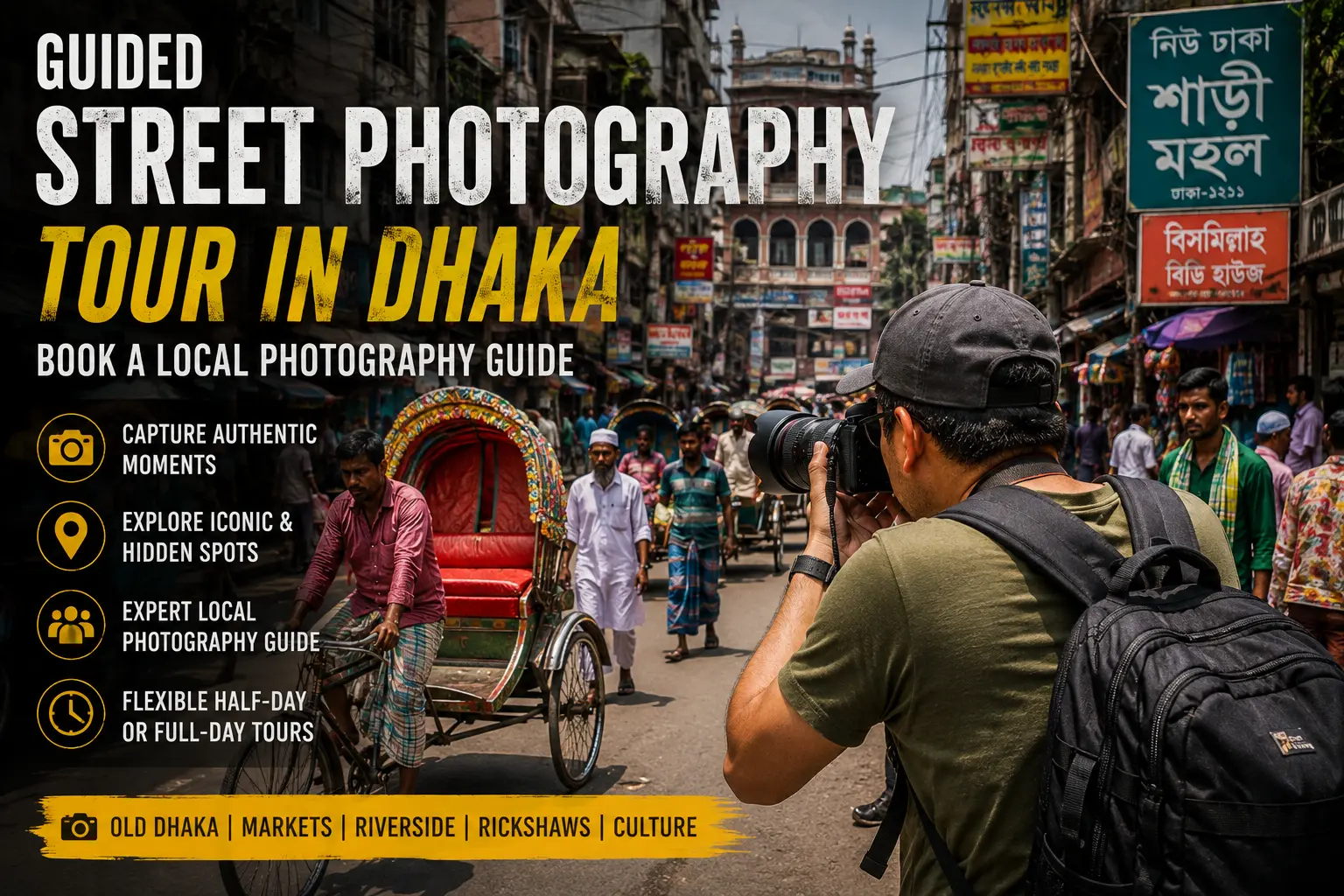
Dhaka is one of those cities where the photograph often changes the way you see the place.
At first, the city can feel fast, crowded, and difficult to navigate. Rickshaws move through narrow gaps in traffic. Porters carry impossible-looking loads through markets. Tea stalls fill with regular customers. Launch terminals, railway areas, old neighborhoods, mosques, workshops, and street corners all have their own rhythm.
For a photographer, that variety is exactly what makes Dhaka compelling.
The challenge is knowing where to go, when to go, and how to move through the city efficiently. That is where a street photography tour Dhaka experience can make a real difference. Rather than spending valuable travel time searching for locations, negotiating transportation, or arriving at the wrong time of day, you explore the city with someone who understands its streets and can help shape the experience around your photographic interests.
This guide is designed for travelers who are considering a guided photography experience in Dhaka. It covers what a local photography guide can offer, the kinds of scenes you can photograph, how to plan your equipment, what to expect from the day, and how to decide whether a guided tour is worth booking.
Why Book a Guided Street Photography Tour in Dhaka?
Dhaka is not a city that always reveals itself immediately.
Some of its best photographic locations are hidden behind crowded roads, inside old neighborhoods, along riverbanks, or in markets that are difficult for first-time visitors to navigate alone. Timing also matters. A market that is visually ordinary in the afternoon may be full of activity before sunrise. A narrow street that looks flat under midday light can become far more interesting when people return from work or when the late afternoon sun reaches the buildings.
That local knowledge is one of the main reasons to book a street photography tour Dhaka experience.
A local photography guide can help you spend more time photographing and less time trying to work out where you are. Instead of following a fixed sightseeing route, the day can be shaped around the kind of images you want to create.
Perhaps you are interested in environmental portraits.
Maybe you prefer busy markets and human activity.
You may want to photograph rickshaws, river life, traditional neighborhoods, religious architecture, workshops, or the contrast between Old and New Dhaka.
A guided experience makes it easier to build the route around those interests.
Several established photography tours in Dhaka focus on locations such as Kawran Bazar, Old Dhaka, Sadarghat, local markets, railway areas, and the Buriganga River. These places consistently appear in photography guides because they offer a concentration of people, movement, work, color, and everyday life.
The real advantage, however, is not simply having someone point at a location and say, “Take photos here.”
A good local guide helps you understand the rhythm of the place.
When should you arrive?
Which route makes sense?
How much walking is involved?
Where can you safely stop with your camera?
When is it appropriate to take photographs, and when should you ask first?
Those practical details can make a major difference, particularly if this is your first visit to Dhaka.
What Makes Dhaka Special for Street Photography?
Dhaka is constantly changing.
A quiet moment can disappear in seconds. A street that looks ordinary suddenly fills with rickshaws. A porter walks past carrying a load that changes the entire composition. Someone stops for tea. A vendor rearranges a display. A boat arrives at the riverbank.
For photographers, that unpredictability is part of the attraction.
You cannot control the city, and that is exactly why the experience can be rewarding.
Dhaka offers a wide range of photographic subjects within a relatively compact area:
- Rickshaws and urban transportation
- Traditional markets
- Street vendors
- River life
- Porters and workers
- Historic neighborhoods
- Narrow lanes
- Artisan communities
- Railway and industrial scenes
- Local food culture
- Street portraits
- Religious and cultural life
- Everyday moments that rarely appear in conventional travel photography
Old Dhaka, in particular, is widely recognized as one of the city’s strongest areas for street photography. Its narrow lanes, historic buildings, markets, workshops, and constant human activity give photographers a wide range of visual opportunities within walking distance.
The important thing is not to arrive with the expectation that every corner will produce a perfect photograph.
Street photography does not work that way.
Some of the best images come from spending time in one location and waiting for the right combination of people, movement, light, and background.
A local guide can make that process easier by helping you reach the right environment at the right time.
Explore Dhaka With a Local Photography Guide
There is a significant difference between joining a standard city tour and taking a photography-focused walk through Dhaka.
A regular sightseeing tour usually follows a schedule.
You arrive at a landmark.
You learn about its history.
You take a few photographs.
Then you move to the next location.
A photography experience needs more flexibility.
If an interesting scene develops, you may want to stay longer.
If the light is not working, it may make sense to change locations.
If a market is particularly active, you might decide to spend an extra thirty minutes there rather than following a rigid timetable.
That flexibility is especially valuable in Dhaka because traffic and daily activity can affect any itinerary.
Some photography operators openly acknowledge that routes may need to change during the day depending on traffic and conditions, which is a sensible approach in a city where travel times can be unpredictable.
Your local guide can also help with the practical side of moving through the city.
That may include arranging transportation between locations, choosing walking routes, helping you navigate busy areas, and explaining what you are seeing.
For international visitors, particularly travelers arriving from the United States, this can remove much of the uncertainty that comes with exploring a large and unfamiliar city alone.
The Best Places to Photograph on a Guided Dhaka Street Photography Tour
The exact route should depend on your interests, available time, traffic, weather, and the type of photography you enjoy. Still, several locations consistently stand out.
Kawran Bazar
For photographers who enjoy early-morning activity, Kawran Bazar can be an excellent place to start.
The wholesale market is full of workers, traders, porters, vehicles, vegetables, fruit, and constant movement. Early hours are generally the most productive because the market’s activity changes as the morning progresses. Photography guides and tour itineraries frequently identify Kawran Bazar as one of Dhaka’s strongest locations for photographing working life and market activity.
This is not a polished tourist attraction.
It is a working environment.
That is exactly why it can produce strong photographs.
A guide can help you move through the market without disrupting the people who are there to work.
Old Dhaka
If Kawran Bazar shows one side of Dhaka’s commercial life, Old Dhaka offers an entirely different environment.
The area is dense, historic, and full of visual layers.
Rickshaws move through narrow streets. Small workshops operate beside homes. Markets spill into the roads. Historic architecture appears between modern signs and tangled electrical wires.
Old Dhaka is large enough that a visitor can easily lose hours simply walking.
That freedom is part of its charm, but it can also be inefficient if you have limited time. A guided photography route can help you focus on neighborhoods and streets that match your interests while still leaving room for unexpected discoveries.
For photographers interested in architecture, portraits, markets, and everyday street life, Old Dhaka can easily become the center of the day.
Sadarghat and the Buriganga River
Sadarghat is one of the most visually active areas in Dhaka.
Passengers arrive and depart. Porters move goods. Vendors work along the riverfront. Ferries and smaller boats create layers of movement across the water.
The location has long been recommended by street photographers because the combination of river traffic and human activity creates scenes that are difficult to find elsewhere in the city.
A guided visit can be particularly useful here because the area is busy and constantly changing.
Your guide can help determine the best time to arrive and, where appropriate, arrange local transport or a boat experience that provides a different perspective on the river.
Shankhari Bazar and the Historic Lanes
Some of the strongest photographs in Dhaka are not found at famous landmarks.
They happen in narrow streets.
Shankhari Bazar and other historic neighborhoods in Old Dhaka offer a more intimate photographic environment, with old buildings, artisan communities, religious spaces, and neighborhood life. These areas are regularly included in photography guides because the visual experience changes from one lane to another.
This is where having a local guide can be particularly useful.
The most interesting route is not always obvious from a map.
Markets, Workshops, and Everyday Working Life
A good photography itinerary should not be built entirely around famous locations.
Some of the most rewarding scenes in Dhaka come from places that visitors would probably never search for by name.
A repair workshop.
A small food stall.
A textile area.
A street where people are unloading goods.
A local tea shop where the same customers gather every morning.
The value of a local guide lies partly in understanding these smaller environments and recognizing what might be interesting on a particular day.
That creates a more personal experience than simply following a list of “top ten photography spots.”
A Photography Tour Built Around Your Interests
Not every photographer wants the same experience.
Someone traveling with a smartphone may be looking for a relaxed introduction to Dhaka’s visual culture. A documentary photographer may want to spend hours in markets and working neighborhoods. Another visitor may be building a travel portfolio and want a mixture of portraits, architecture, transportation, and river scenes.
A guided street photography tour in Dhaka should take those differences into account.
Before the tour begins, it helps to consider what you want to photograph.
You may prefer:
- Candid street photography
- Environmental portraits
- Documentary photography
- Markets and working life
- Rickshaws and transportation
- Historic architecture
- River and boat photography
- Local food culture
- Artisan workshops
- Urban landscapes
- Human-interest storytelling
Your route can then be adjusted accordingly.
This is one of the biggest gaps in many generic photography tours. Some focus heavily on a fixed itinerary or simply transport visitors between photogenic locations. Others clearly state that they provide a guide rather than professional photography instruction.
For travelers booking a local experience, it is useful to understand the difference before confirming the tour.
A local photography guide may provide destination knowledge, route planning, cultural context, practical assistance, and access to photogenic areas. If you specifically want technical photography coaching, portfolio reviews, or instruction in composition and camera settings, you should confirm in advance whether those services are included.
Setting the right expectation leads to a much better experience.
Do You Need to Be a Professional Photographer?
No.
You do not need an expensive camera or years of experience to enjoy a street photography tour Dhaka experience.
A smartphone can be enough.
A compact camera can be enough.
A mirrorless or DSLR camera with one or two lenses is also perfectly suitable.
What matters more is your curiosity.
Dhaka offers so much activity that even beginners can find interesting subjects. The key is to avoid trying to photograph everything at once.
Slow down.
Choose a scene.
Watch what happens.
Wait for people to move into the frame.
Pay attention to backgrounds.
Notice how light changes.
These simple habits can make a greater difference than carrying a large amount of expensive equipment.
Experienced photographers, meanwhile, may appreciate the opportunity to spend more time in specific locations and follow their own creative direction.
What Camera Gear Should You Bring?
One of the easiest mistakes travelers make is bringing too much equipment.
Dhaka can involve long periods of walking, crowded streets, rickshaw rides, and changing weather. Carrying multiple heavy camera bodies and a large collection of lenses may quickly become uncomfortable.
For most photographers, a practical setup is usually better.
Consider bringing:
- One primary camera body
- A versatile lens
- An additional lens only if you know you will use it
- Extra batteries
- Memory cards
- A lightweight rain cover during the wet season
- A comfortable camera strap
- A small bag that does not attract unnecessary attention
A wider lens can work well in crowded markets and narrow streets where you want to include more of the environment. A moderate focal length may be useful for portraits and scenes where you want to keep a little more distance.
There is no perfect setup.
The best equipment is the equipment you can comfortably carry for the day.
If you are traveling with heavier gear, let your guide know in advance. Planning transportation and walking distances around your equipment can make the experience much more comfortable.
Is Dhaka Safe for Street Photography?
Dhaka can be an exciting place for photography, but it is still a large and crowded city, and common-sense precautions are important.
Keep your camera secure in busy areas.
Avoid leaving equipment unattended.
Be aware of traffic, particularly when stepping backward to frame a photograph.
Do not block workers, vehicles, or narrow pathways.
And always remain aware of what is happening around you rather than becoming completely absorbed in your camera.
A local guide can help you navigate these situations, particularly in crowded markets and unfamiliar neighborhoods.
Photography is also about human interaction.
In some situations, people may be happy to be photographed. In others, it is better to ask.
A smile, a gesture, or a simple introduction can often make the difference between taking a photograph of someone and creating a more respectful interaction.
If someone does not want to be photographed, move on.
Dhaka offers another photograph around almost every corner.
Photography Etiquette and Respect for Local People
The strongest travel photographs often come from genuine human moments.
That does not mean every person should automatically become a subject.
A good street photography experience should include an understanding of local etiquette.
Your guide can help explain the context of different locations, particularly religious sites, workshops, markets, and residential neighborhoods.
A few simple principles can make your photography more respectful:
- Ask before taking close portraits when appropriate.
- Respect anyone who declines to be photographed.
- Avoid photographing people during sensitive or private moments.
- Do not interrupt someone who is working.
- Be particularly respectful around religious sites.
- Do not enter private spaces without permission.
- Avoid treating people as props for a travel photograph.
The best photographs usually benefit from patience.
Spend time in a place.
Buy a tea.
Talk to someone.
Observe what is happening.
Often, the image becomes more meaningful once you understand something about the person or environment in front of you.
A Typical Street Photography Tour Itinerary in Dhaka
Every day in Dhaka is different, so the itinerary should remain flexible.
A full-day experience might begin early, particularly if Kawran Bazar or another morning market is part of the route. From there, the day could move through selected areas of Old Dhaka before continuing toward the Buriganga River and Sadarghat.
A sample photography-focused day could include:
Early Morning: Meet your local guide and travel to an active market or working neighborhood.
Morning: Photograph Kawran Bazar, local streets, workers, vendors, and the surrounding urban environment.
Late Morning: Continue toward Old Dhaka and explore historic lanes, markets, rickshaw traffic, and neighborhood life.
Lunch Break: Stop for a traditional Bangladeshi meal and take a break from the intensity of the streets.
Afternoon: Explore additional locations based on your interests, which may include Shankhari Bazar, artisan areas, local markets, or historic streets.
Late Afternoon: Finish around Sadarghat or another visually active location where river life and changing light create new photographic opportunities.
The route is only a starting point.
Traffic, weather, local events, and activity levels may lead to changes during the day. Flexible itineraries are common among Dhaka photography tours for exactly that reason.
Guided Photography Tour vs Exploring Dhaka Alone
You can absolutely explore Dhaka independently.
In fact, independent wandering is part of the appeal of street photography.
However, a guided experience can be a better choice when:
- You are visiting Dhaka for the first time.
- You have limited time in the city.
- You want to photograph specific types of locations.
- You are unfamiliar with local transportation.
- You are carrying valuable camera equipment.
- You want cultural context alongside the photography.
- You prefer a flexible route instead of navigating on your own.
- You want help communicating in local environments.
The value is not simply in being taken somewhere.
It is in reducing the time and uncertainty involved in finding the right places yourself.
For a visitor with only one or two days in Dhaka, that can be significant.
How Much Does a Street Photography Tour in Dhaka Cost?
The price of a photography tour in Dhaka can vary considerably depending on the length of the experience, whether it is private or shared, the number of travelers, transportation, meals, entrance fees, and the level of customization.
Current market listings show photography-focused experiences ranging from roughly $60 per person for some group or private options to around 180–200 for private full-day experiences designed for one or two travelers.
When comparing prices, do not look only at the number.
Ask what is included.
For example:
- Is hotel pickup included?
- Is private transportation included?
- How many hours does the tour last?
- Are local transport and boat rides covered?
- Is lunch included?
- Is the experience private or shared?
- How many people will be in your group?
- Can the itinerary be customized?
- Is the guide photography-focused or a general sightseeing guide?
These questions will help you understand the real value of the experience.
For photographers traveling from the USA, booking directly with a local operator can also make it easier to discuss your interests and arrange a route before arriving in Bangladesh.
Private Tour or Small Group: Which Is Better?
Both options can work well, depending on what you want.
A small group tour can be more affordable and enjoyable if you like meeting other travelers.
A private tour offers more flexibility.
You can spend longer at a particular location.
You can change the route if something interesting appears.
You can move at your own pace.
And you do not need to worry about whether other people in the group are ready to leave while you are waiting for a photograph.
For serious photographers, a private experience is often the better choice.
For casual travelers, couples, friends, or people simply interested in experiencing Dhaka through a different lens, a small group can offer good value.
The most important factor is knowing what you want before booking.
Combine Street Photography With a Wider Dhaka Experience
Photography can be the main purpose of your day, but it can also become part of a broader cultural itinerary.
If you are particularly interested in historic neighborhoods, an Old Dhaka Tour can provide a deeper introduction to the area’s history, architecture, markets, and local culture.
Travelers who want to experience the city through its food may also enjoy a Dhaka Food Tour, where markets, traditional dishes, and local culinary traditions provide a completely different way to understand the capital.
For visitors with limited time, a Half-Day Tour Dhaka can be a practical option when a full photography day does not fit the schedule.
These experiences work particularly well together because photography gives you a visual record of the city, while food, history, and cultural exploration help you understand the stories behind what you have photographed.
When Is the Best Time for Street Photography in Dhaka?
The answer depends on what you want to photograph.
For markets and working life, early morning can be ideal.
Kawran Bazar and similar commercial areas are particularly active during the morning hours.
For Old Dhaka, an early start can also help you photograph before the heat and traffic become more intense. Some detailed photography guides recommend early mornings for better light and a more manageable walking experience.
Late afternoon can be rewarding around the river and other open locations where the changing light creates more atmosphere.
In terms of season, many international travelers find the cooler and generally drier months from approximately October through March more comfortable for extended walking and outdoor photography.
However, the monsoon season has its own visual character.
Rain, reflections, umbrellas, darker skies, and dramatic street scenes can create completely different photographic opportunities.
There is no universally perfect season.
It depends on the kind of story you want to tell.
What to Wear for a Photography Tour in Dhaka
Comfort is more important than style.
Choose lightweight clothing suitable for walking and warm weather. Comfortable shoes are essential because a photography tour can involve several hours on foot.
It is also useful to dress modestly and practically, particularly when exploring traditional neighborhoods or religious areas.
A small backpack or camera bag is usually easier to manage than a large, bulky bag.
If you are traveling during the hotter months, carry water and sun protection. During the rainy season, a compact rain jacket or cover for your camera can be useful.
Most importantly, be prepared for the unexpected.
Street photography rarely follows a perfectly controlled schedule.
You may find yourself walking farther than expected because something interesting is happening around the next corner.
Is This Tour Suitable for Smartphone Photographers?
Yes.
You do not need a professional camera to enjoy the experience.
Modern smartphones are capable of producing excellent travel and street photographs, particularly in good light.
A local guide can still provide value because the location, timing, cultural context, and route planning remain the same regardless of which camera you use.
Smartphone photographers may even find the experience easier in some situations because the equipment is lighter and less intrusive.
The most important thing is to approach the day as a visual experience rather than worrying too much about technical equipment.
Look carefully.
Move closer when appropriate.
Pay attention to light.
Wait for the right moment.
Those habits matter whether you are using a phone or a professional camera.
Why Book a Local Guide Instead of Following a Free Photography Map?
A free guide can tell you where to go.
It cannot tell you what the location feels like on that particular morning.
It cannot know whether a market is unusually quiet, whether traffic has changed the route, or whether another nearby location is currently more active.
That is where local knowledge becomes valuable.
Dhaka is not a museum with a fixed exhibition.
It changes every day.
A photography guide can respond to those changes.
If one location is not working, the route can be adjusted.
If the light is good somewhere unexpected, you can stay longer.
If you discover a particular interest during the day, the experience can move in that direction.
That flexibility is difficult to get from a map or a list of locations.
Book Your Guided Street Photography Tour in Dhaka
Dhaka rewards photographers who are willing to look beyond the obvious.
The city is not always easy.
It is busy, noisy, crowded, and unpredictable.
But those same qualities create photographs with energy and character.
A street photography tour Dhaka experience gives you the opportunity to explore the city with someone who understands its rhythm while keeping the day focused on what matters most to you: finding interesting places, meeting people, observing everyday life, and creating images that tell a story.
Whether you are carrying a professional camera, a small mirrorless setup, or simply your smartphone, a local guide can help you make better use of your time in one of South Asia’s most visually compelling cities.
Come with curiosity.
Travel light.
Be patient.
Respect the people you photograph.
And give yourself enough time to see what happens when you stop chasing the next landmark and start paying attention to the street in front of you.
FAQ
What is a street photography tour in Dhaka?
A street photography tour in Dhaka is a guided experience designed around photographing everyday life, markets, historic neighborhoods, river activity, rickshaws, people, and other aspects of the city’s visual culture. The route can include places such as Old Dhaka, Kawran Bazar, Sadarghat, and other local areas depending on the itinerary.
Do I need a professional camera?
No. You can join with a DSLR, mirrorless camera, compact camera, or smartphone. The experience is suitable for beginners as well as experienced photographers.
Is a local photography guide included?
A guided photography tour normally includes a local guide who helps with route planning, navigation, transportation arrangements, cultural context, and access to suitable photography areas. Before booking, confirm whether the guide also provides technical photography instruction.
What are the best places for street photography in Dhaka?
Old Dhaka, Kawran Bazar, Sadarghat, the Buriganga River, Shankhari Bazar, local markets, and selected railway or working areas are among the most frequently recommended photography locations.
How long is a Dhaka street photography tour?
A photography tour can range from a few hours to a full day. A full-day experience allows more flexibility and makes it easier to photograph different parts of the city without rushing.
How much does a street photography tour in Dhaka cost?
Prices depend on whether the experience is private or shared and what is included. Current market listings show options from around $60 per person for some tours, while private full-day experiences can cost approximately 180–200 for one or two travelers.
Is Dhaka safe for photographers?
Dhaka can be rewarding for photographers, but visitors should use normal precautions in crowded areas, keep equipment secure, remain aware of traffic, and respect local people and customs. A local guide can be particularly helpful for first-time visitors.
What should I wear on a photography tour?
Wear lightweight, comfortable clothing and good walking shoes. Dhaka photography tours can involve several hours of walking, crowded streets, and changing weather conditions.
Can I customize the photography itinerary?
A private photography experience may offer greater flexibility to focus on your interests, such as portraits, markets, architecture, river life, food, or documentary photography. Confirm customization options when booking.
What is the best time of day for photography in Dhaka?
Early morning is excellent for markets and working life, while late afternoon can offer softer light and strong river or street scenes. The best time ultimately depends on the locations and subjects you want to photograph.
Can beginners join a guided street photography tour?
Yes. Beginners can join, and no advanced photography experience is required. The tour can be just as enjoyable for someone using a smartphone as for an experienced photographer carrying professional equipment.
Should I ask people before taking photographs?
In many situations, particularly for close portraits, asking permission is the respectful approach. Your local guide can help you understand the context and communicate when necessary.